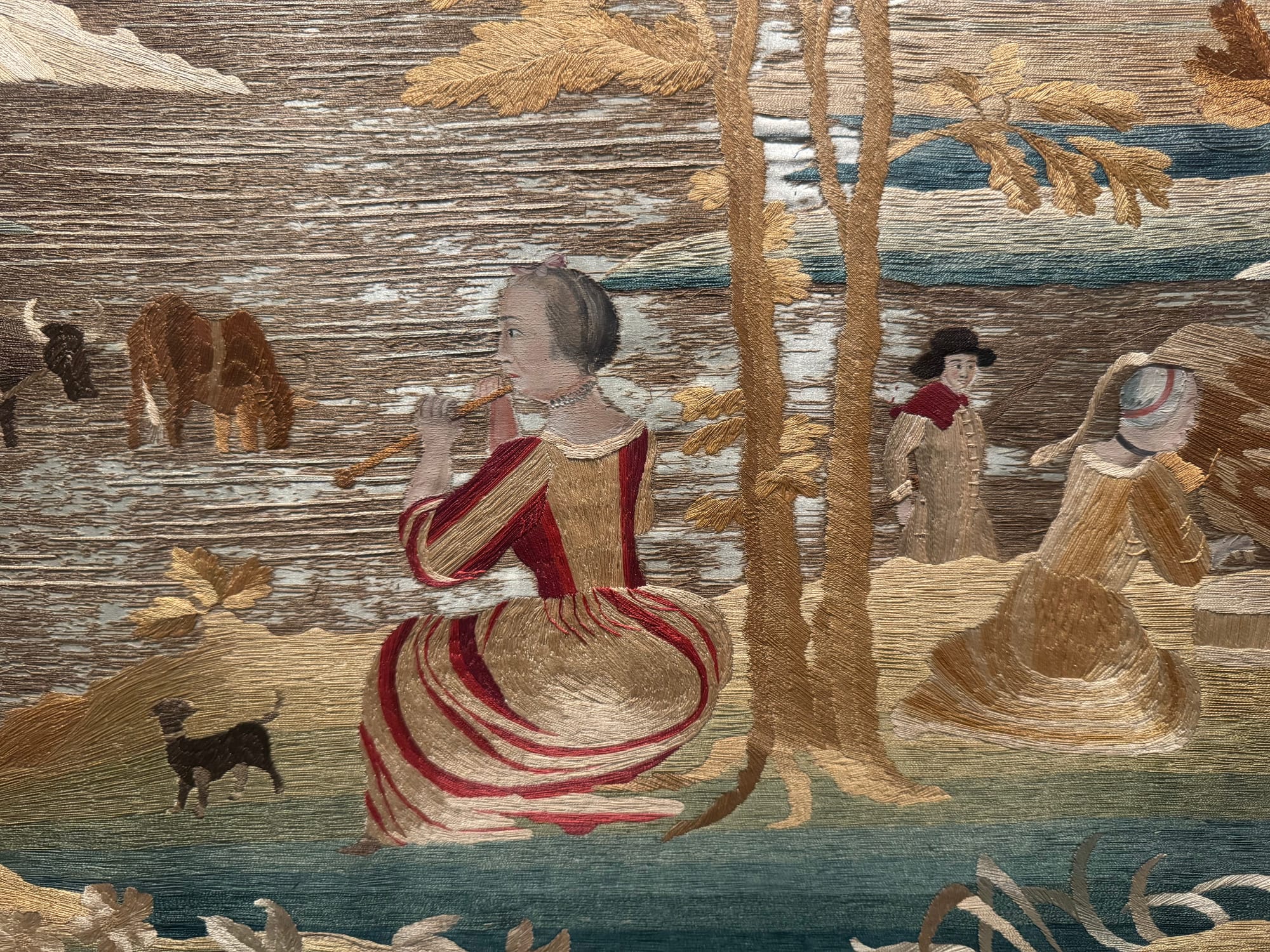
The Hudson River School, founded by Thomas Cole’s academic style of landscape painting, emerged around the 1830s, but what if I told you that the first distinctly American art movement was actually produced by women decades earlier? Women and girls of New England in the 18th and 19th centuries made landscape scenes in needlework, oil, and watercolors, filling rolling hills with wildlife and dotting harbors with soldiers in red coats. This work, and the proposition of its unappreciated preeminence, is the subject of a new exhibition, Locating Girlhood: Place and Identity in Early American "Schoolgirl" Art, at the American Folk Art Museum. “Schoolgirl” art became a collecting category by the early 1950s and is still used in the art market today. By placing the term in quotation marks, the museum hints at an understanding of its “belittling connotations” and instead favors “girlhood embroidery” or “student artworks.” Faith Trumbull is perhaps one of the best-known artists in the exhibition. At a young age, she developed highly technical skills in painting and drawing at a finishing school, incorporating embroidered silk thread, gouache, and mica flakes into her panels. In a 1754 needlework, brown and yellow leaves recall late autumn in New England. The water appears frosty, glittering white as cows stand knee-deep and shivering. The work achieves such a fine degree of realism that it is mystifying how the artist completed it at just 11 years old.
Hyperallergic · Read at the source / Lire à la source
Activism · EN · A pointer: the title and first lines with credit, not a copy.